Asie-sud-est Le Cirad en Asie du Sud-Est Philippines
In the framework of the Science and Technology agreement signed by the Philippines and France in 1978, CIRAD started its cooperation with PCARRD in 1987 in agriculture and natural resources. Many regional and international organizations having their headquarters in the Philippines (ADB, SEARCA, IRRI), the Philippines play at the regional level a key role. Working with these organizations gives to Cirad the opportunity to scale up his action, to reach a higher number of scientists for scientific collaboration and for capacity building and to deliver at a regional and global level.
In the Philippines, agriculture represents 5 % of GDP and the poor 30 % of the population. The country was directly affected by the recent food and sanitary crisis. Addressing these questions needs regional approaches and CIRAD scientists in other ASEAN countries involve the Philippines in their research to analyze and prevent the crisis. These research orientations led to open new areas of co-operation fitting better with the economic level of the country.
In 2010, in line with the Millennium Development Goals, CIRAD concentrates his activities on 3 of its research priority lines:
With an archipelago of more 7000 islands, fishing and aquaculture supply more than 4.7 million tons of products and contribute to 23% of agriculture incomes. Aquaculture itself is the 10th in the world (2nd for aquatic plants), implemented mostly in brackish-water in estuaries and surrounding low-lying areas. Three species are dominant: Tiger prawns (Penaeus monodon), Milkfish (Chanos chanos) and Tilapias (Oreochromis niloticus). Although very successful until now, aquaculture sector currently faces new challenges such as the need for an ecological intensification of extensive ponds, the massive fish kills due to growing pollution or the need for modernization by complying with the new international food safety and quality standards. In this context, CIRAD, in close partnership with BFAR, is working on the study and support to the brackish-water coastline fishponds production. Two mains programs are in progress: an on-going selection from an interspecific hybrid population of two strains of fast growing and salinity tolerant Tilapia and a multidisciplinary assessment of the strategies of various aquaculture actors induced by a successful compliancy process with European Food Law (in partnership with IEP-Paris, University of Stirling-UK and UMR Moisa).
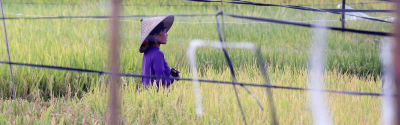
Rice (Oryza sativa L.) is the major staple food in Asia where about 92 percent of the world’s rice is produced and consumed. More than 75 percent of the world’s rice supply comes from 79 million hectares of irrigated lowlands in Asia which provides 35-80 percent of the total calorie intake of Asians. Thus, the present and future food security of Asia depends largely on the irrigated rice production system where irrigated rice accounts for about 50 percent of the total amount of water diverted.
In the global framework of the cooperation between CIRAD and IRRI, a specific project implemented at Los Banos, aims at improving resources use efficiency in favourable growing conditions and approaching yield potential of high-yielding varieties. The objective of this work consists in improving plant-type related crop management and identifying effective plant traits for phenotype improvement under optimal input conditions, intermittent irrigation and direct-seeding. The main outcome will be to set up promising combinations between plant types, climate conditions and cultural practices. More precisely, the expected outputs are:
Gilles Saint-Martin
Cirad Regional Director for Insular Southeast Asia

Plaza Bisnis Kemang, 3rd fl
Jl. Kemang Raya No 2
Jakarta 12730
Indonesia
Tel: +62 21 719 9067/4601
Fax: + 62 21 7179 3304